Build your Knowledge Base
Grounding is only as good as what you feed it. This lesson is about choosing sources, not just uploading them.
Transcript
The full voiceover, so you can read it, search it or skim it instead of watching.
Your Brand Kit told scaile how to sound. The Knowledge Base tells it what is true. It sits under Context, one line below the Brand Kit. Everything the platform writes is grounded in what you put here. So this lesson is about choosing sources. It is not about uploading them.
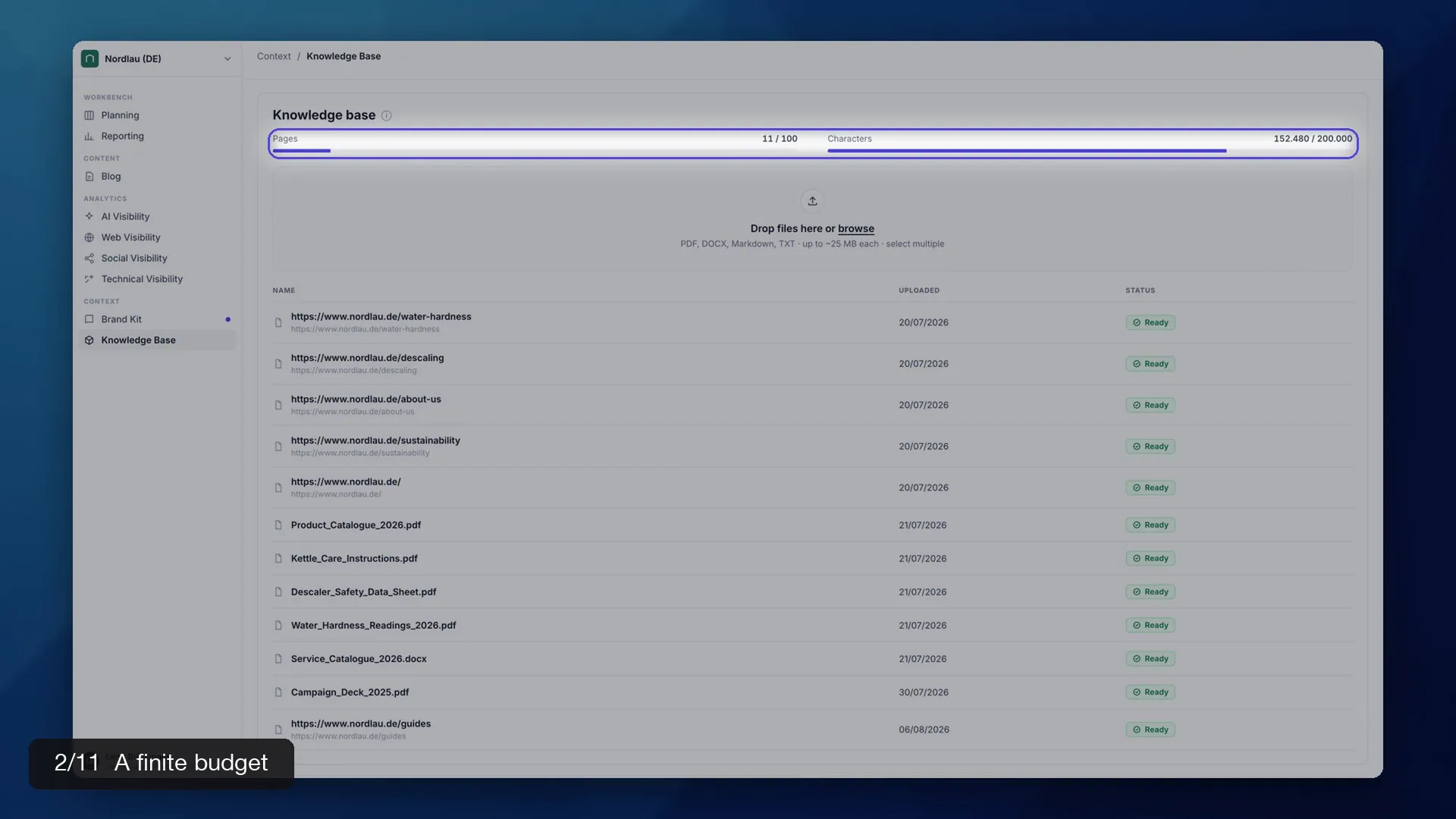
Two numbers at the top set the shape of the job. Pages, and characters. Both are capped. That is the whole reason this lesson exists. You are not archiving everything your company owns. You are choosing the small set of documents worth grounding on.
Files go in here. PDF, Word, Markdown and plain text, up to about twenty-five megabytes each. Load your product documentation. Load your specifications and your technical notes. And load the figures you would be comfortable seeing quoted back to you in public.
Not everything you need is a file. Add by URL takes a page from your own site. Scaile fetches it, extracts the text in the background, and stores it alongside the uploads. Your water hardness table is probably already published. Point at it rather than exporting it again.
Everything you have loaded sits in one list. The name, the day it went in, and a status. Ready means the text has been extracted and indexed, and the writer can retrieve from it. Crawled pages and uploaded files sit in the same list. They are treated the same way.
Now the part that matters more than volume. A good source is specific. It is dated. And it is owned by someone who would notice if it went wrong. The care instructions for the kettle are a good example. They are precise, and somebody in the product team maintains them.
A source that ages badly is vague, undated and orphaned. Last year's campaign deck is the classic example. Nobody owns it. Half of it was aspirational when it was written. And none of it carries a date. It will still be quoted as fact.
One category deserves its own warning. Anything describing a competitor ages fastest of all. It also carries the most risk when it is wrong. Load it only if you must. Put the date in the filename, because there is no date field to put it in. And expect to come back to it.
There is a way to check your own judgement. The search box at the foot runs the same retrieval the writer uses when it drafts. Ask it a question a buyer would ask. What comes back is what the writer will have to work with. If it comes back thin, the gap is in your sources. It is not in the model.
Which brings us to keeping this current. There is no review date here to remind you, so the discipline is yours. The budget does the reminding instead. As you approach the page limit, something has to earn its place. Hover a row and delete the campaign deck. Add the page you actually maintain. Do that as it happens, and you never need the quarterly clean-up.
Both foundations are now in place. Your Brand Kit says how you sound. Your Knowledge Base says what is true. From here on, everything scaile writes stands on the two of them.